
From Emotion to Canvas – The process behind the Blue series
Introduction to the process behind the Blue series
Every artwork begins long before the first brush touches the surface, and in the case of the Blue Series, the process does not start with color, composition, or even the subject itself, but with a state of mind that is quiet, observant, and deeply attuned to subtle shifts in emotion, presence, and atmosphere.
This is not a fast process, and it is not meant to be.
It unfolds slowly, often without a clear endpoint in the beginning, guided more by intuition than by strict planning, and shaped by an ongoing dialogue between feeling and form, where each decision is influenced by what the work seems to ask for rather than what the artist initially intended.
In contemporary portrait art, especially within a restrained and monochromatic framework like the Blue Series, the process becomes just as important as the final image, because what you see on the surface is only the visible result of many layered choices, adjustments, and moments of hesitation that collectively shape the presence of the work.
And that presence is what ultimately defines whether a piece resonates.
Not perfection. Not technical execution alone.
But the ability of the artwork to hold attention, to carry emotion, and to remain relevant long after the initial impression has passed.
Where It Begins – Emotion Before Image
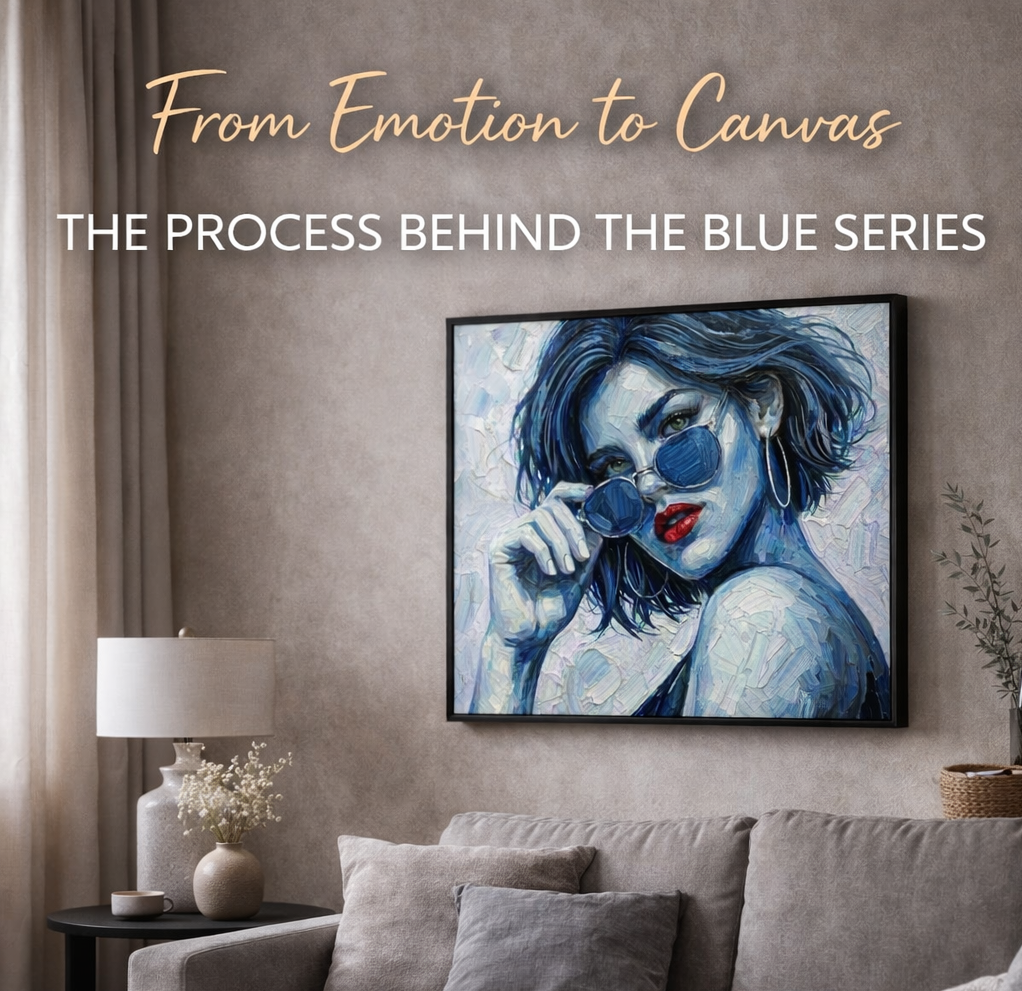
Before there is a subject, there is a feeling.
This is the foundation of the Blue Series, and it is what separates it from more traditional approaches to portrait painting, where the process often begins with a reference, a model, or a predefined composition.
Here, the starting point is far less concrete.
It may be a moment of stillness, a certain type of light, a memory, or even a subtle shift in mood that cannot easily be explained, but is felt strongly enough to demand expression.
These emotional fragments are not immediately translated into visual form, but rather allowed to settle and evolve, sometimes over hours, sometimes over days, until they begin to suggest a direction.
At this stage, there is no pressure to define the outcome.
In fact, trying to do so too early would limit the depth of the work.
Instead, the process remains open, allowing the emotional tone to guide the early decisions without forcing them into a rigid structure.
This creates a foundation that feels organic rather than constructed, where the artwork grows out of something real rather than being assembled from predetermined elements.
And this is crucial.
Because when the emotional starting point is authentic, it becomes much easier to maintain that authenticity throughout the entire process.
Translating Emotion Into Form
The transition from emotion to image is never direct.
It requires interpretation, reduction, and a willingness to let go of unnecessary detail in order to focus on what truly matters.
In the Blue Series, this means simplifying the composition to its essential elements, where the face becomes the central focus and everything else is either minimized or removed entirely.
This is not about creating minimalism for its own sake, but about creating clarity.
Too many elements dilute the emotional impact.
Too much detail distracts from the presence of the subject.
By reducing the composition, the focus becomes sharper.
More intentional.
More immediate.
At the same time, the form itself is not rigidly defined.
Edges remain soft in certain areas, allowing the figure to emerge gradually rather than being fully outlined from the beginning.
This creates a sense of movement within stillness, where the image feels alive rather than static.
It also allows for flexibility.
Because at this stage, the painting is still evolving.
Nothing is fixed.
Everything can still change.
And that openness is what allows the work to develop depth.
This also aligns with modern feminine portrait art and its focus on presence.
Building the Surface – Layers, Texture, and Time
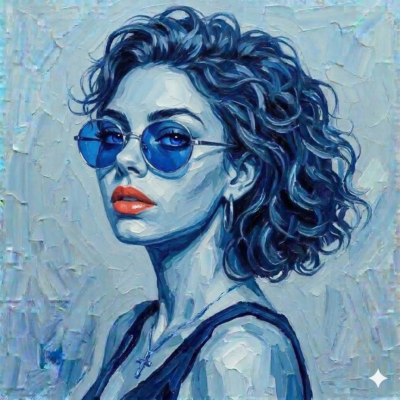
Once the initial form begins to take shape, the focus shifts to the surface.
This is where the physical process becomes more visible.
Layers are added gradually, each one influencing the next, creating a sense of depth that cannot be achieved in a single pass.
The blue tones are not applied uniformly.
They are built.
Adjusted.
Sometimes removed and reapplied.
This layering process is essential, because it introduces variation within a limited palette, allowing the color to feel rich and complex rather than flat.
Texture plays a central role here.
Brushstrokes are not hidden.
They are allowed to remain visible, to create movement across the surface, and to give the work a tactile quality that draws the viewer closer.
At times, the paint is applied more thickly, creating areas of density.
At other times, it is thinned out, allowing the underlying layers to show through.
This contrast between density and transparency adds another dimension to the work.
It creates rhythm.
It creates tension.
And it ensures that the surface continues to reveal new details over time.
But this process requires patience.
There are moments where nothing seems to happen.
Where the painting feels stuck.
Where every adjustment seems to move it further away from the intended direction.
And in those moments, the most important decision is often to step back.
To wait.
To allow the work to settle before continuing.
Because forcing the process rarely leads to better results.
It only disrupts the balance that is trying to emerge.
Working Within Restraint – The Discipline of a Limited Palette
One of the defining characteristics of the Blue Series is its restricted color palette, and while this may appear limiting at first, it is precisely this limitation that creates focus and depth.
Working within a narrow range of blue tones forces every variation to matter.
There is no reliance on contrast through color alone.
Instead, contrast is created through value, texture, and subtle shifts in tone.
This requires a different kind of attention.
A more precise way of seeing.
Because when the palette is reduced, small changes become significant.
A slightly darker tone can alter the entire mood of the piece.
A softer transition can shift the emotional reading.
This level of sensitivity to nuance is what allows the work to feel controlled without becoming rigid.
It also creates cohesion across the series.
Each piece belongs to the same visual language, even as the compositions and expressions vary.
And this consistency is important.
Not just aesthetically, but conceptually.
Because it reinforces the idea that the Blue Series is not a collection of unrelated works, but a continuous exploration of a specific emotional and visual territory.
The choice of color is rooted in the meaning of blue in art.
Knowing When to Stop
Perhaps the most difficult part of the process is knowing when the work is complete.
There is no clear signal.
No defined endpoint.
Only a sense that the painting has reached a state where further adjustments would not improve it, but begin to take something away.
This requires restraint.
And trust.
Because it is always possible to continue refining, to smooth out imperfections, to add more detail.
But in doing so, you risk losing the energy that made the work compelling in the first place.
In the Blue Series, completion is not defined by perfection, but by balance.
When the composition feels stable.
When the emotional tone feels clear.
When the surface holds together without feeling overworked.
That is when the process stops.
The technical side of printmaking is explored further in giclée printing on Hahnemühle paper, where quality meets precision.
From Canvas to Fine Art Print
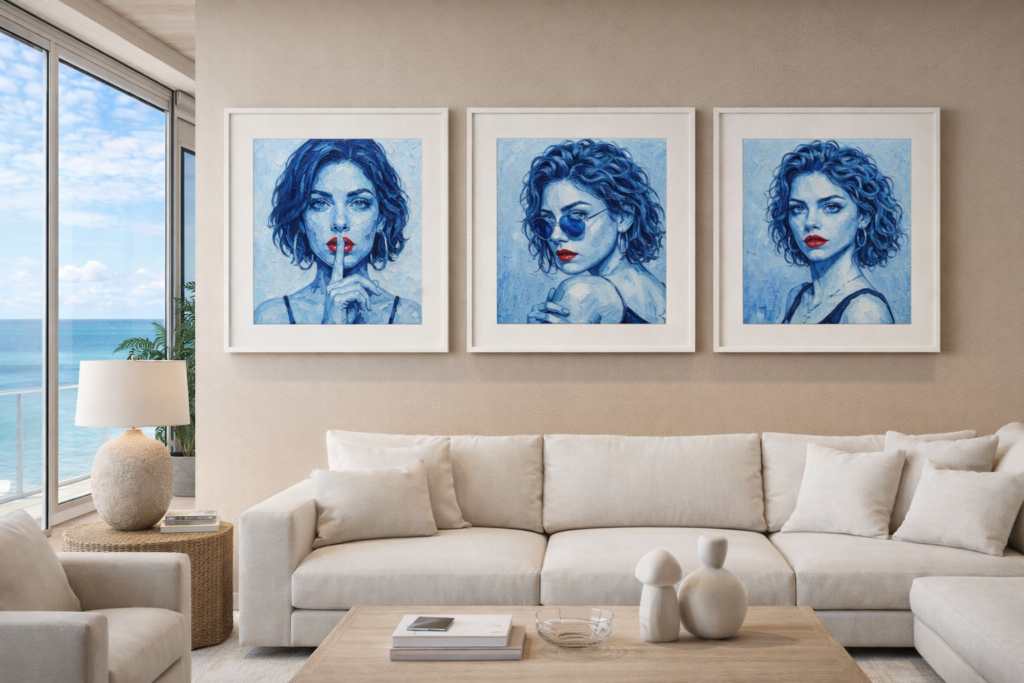
Once the original artwork is complete, the next stage is translation.
And this stage is just as important as the creation itself.
Because a poorly executed print can flatten the work, removing the very qualities that make it unique.
In the Blue Series, each piece is reproduced as a fine art print using high-quality materials, specifically Hahnemühle paper, which is chosen for its ability to retain both color depth and surface texture.
The goal is not to create an exact replica of the original, but to preserve its presence.
To maintain the subtle variations in tone.
To keep the texture visible.
To ensure that the print still feels like a physical object, rather than a digital reproduction.
This requires careful calibration.
Precise color matching.
And a deep understanding of how the original translates into print form.
Because every decision made during this stage affects how the final piece is experienced.
Every step in the process contributes to what ultimately becomes the Blue Series.
Limited Editions as Part of the Process
The decision to produce the Blue Series as limited edition art is not purely commercial.
It is part of the conceptual framework.
By limiting the number of prints, each piece retains a sense of exclusivity.
A defined existence.
It is not endlessly reproduced.
It has boundaries.
This aligns with the overall approach of the series, where restraint and intention guide every aspect of the work.
Each print is signed and numbered, accompanied by a certificate of authenticity, and in some cases, enhanced with hand-finished details that add a unique element to each piece.
This ensures that even within an edition, there is variation.
No two pieces are entirely identical.
And this connection to the original process remains intact.
The Role of Process in Contemporary Art
In contemporary art, the process is often as significant as the final image.
Not because it needs to be explained, but because it shapes the outcome in ways that are felt, even if they are not immediately visible.
The Blue Series is built on this idea.
That what happens beneath the surface matters.
That the time, the hesitation, the adjustments, and the decisions all contribute to the final presence of the work.
And while the viewer may not see every step, they experience the result.
A sense of depth.
A sense of control.
A sense that the artwork holds something beyond what is immediately visible.
Explore the Blue Series
The Blue Series is an ongoing exploration of emotion, identity, and presence, translated through a disciplined process that values restraint, depth, and subtle variation over immediate impact.
Each piece carries the marks of that process.
Not as visible steps, but as a cohesive presence that continues to reveal itself over time.
If you are interested in experiencing the results of this process, and in exploring how these works function within real spaces, the Blue Series offers a collection of limited edition fine art prints that retain the essence of the original paintings.