
Why Hand-Finished Fine Art Prints Matter More Than Ever
In a time when images are endlessly replicated, resized, and reproduced at scale, it has become increasingly difficult to tell what is made with care and what is simply produced. For artists and collectors who value presence, tactility, and intention, this distinction matters.
At Miss Art Lover, the work has always been about feeling as much as seeing. Boho art, at its best, is not just visual — it is textural, human, and quietly expressive. This is why the way an artwork is finished is just as important as the image itself.
This is also why the hand-finished approach used by FineArtKlub resonates so strongly with our philosophy.
The Meaning of “hand-finished fine art prints”
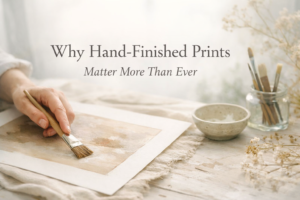
A hand-finished print carries subtle evidence of human involvement.
Edges are carefully handled.
Surfaces are inspected one by one.
Small variations are accepted rather than erased.
These details are often invisible at first glance, but they are felt over time. A hand-finished print does not feel interchangeable. It feels specific. It carries the sense that someone was present during its making.
This presence is especially important in boho fine art, where warmth, imperfection, and individuality are not flaws, but essential qualities.
Why Hand Finishing Changes the Relationship With Art
When an artwork is hand-finished, the relationship between object and owner changes.
The print no longer feels like a product.
It feels like an object that passed through human hands.
This creates care. And care creates longevity.
Collectors who live with hand-finished prints often describe a deeper connection to the work. It becomes something they notice daily — not because it demands attention, but because it belongs naturally in the space.
This is the opposite of disposable décor.
From Image to Object
One of the challenges of contemporary art consumption is that most works are first encountered as images on a screen. Screens flatten texture. They remove scale. They erase material nuance.
Hand finishing restores what screens remove.
It reminds us that fine art is not just something to look at, but something to live with. This idea is explored in depth in The Complete Guide to Fine Art Prints →
https://fineartklub.com/the-complete-guide-to-fine-art-prints/
Understanding how a print is made — and finished — allows collectors to see the difference between something designed to last and something designed to sell quickly.
Quality Is Felt Over Time
Cheap prints often look acceptable at first. The problems appear slowly.
Edges degrade.
Surfaces lose depth.
Colors flatten or shift.
Hand-finished fine art prints resist this quiet erosion. They are made to age well, to remain stable, and to retain their emotional presence in a space.
This is why quality is not about luxury. It is about responsibility.
FineArtKlub’s approach aligns with this belief, as explained in Why High-Quality Prints Outlast Cheap Posters →
https://fineartklub.com/why-high-quality-prints-outlast-cheap-posters/
For boho art especially — where subtle color transitions and organic forms matter — this difference is critical.
How This Connects to Boho Art
Boho art has always celebrated the human hand.
From traditional crafts to contemporary interpretations, boho aesthetics value irregularity, warmth, and personal expression. A hand-finished print naturally supports these values.
It avoids the sterile perfection of mass production.
It allows variation.
It preserves the artist’s intention.
This is why hand-finished prints feel at home in boho interiors. They do not overpower a space. They settle into it.
For examples of how boho fine art integrates into modern living spaces, you can explore our article on boho fine art prints for modern interiors →
https://missartlover.com/boho-fine-art-prints-for-modern-interiors/
Choosing Prints With Intention
Choosing a hand-finished print is not about collecting more. It is about collecting better.
It is about asking:
-
Was care taken at every stage?
-
Does this object feel meant to last?
-
Can I imagine living with this for years?
When the answer is yes, the artwork becomes part of daily life rather than background decoration.
This is where Miss Art Lover and FineArtKlub align most closely — in the belief that art should slow us down, not rush past us.
A Quiet Commitment to Craft
Hand finishing is not dramatic. It does not announce itself loudly. But it is a commitment — to the artist, to the collector, and to the future of the work.
In a fast world, these quiet commitments matter.
They remind us that art is not just seen.
It is made.
And making leaves a trace.
That trace is what makes art feel human.